
Debunking Chiropractic Myths: Is Cracking Dangerous?
Recently, a few clients who had their first chiropractic adjustment asked me: “Is that cracking sound dangerous?”, “Are my bones breaking?”, “What is going on??”
All totally valid questions, let’s break it down.

So… what actually is the “crack”?
The scientific term for it is a cavitation. What produces it is actually still debated. Two theories exist: one says it’s nitrogen gas bubbles being released in the joint fluid, the other says it’s a gas bubble being created through negative pressure in a process called tribonucleation [Chandran Suja & Barakat, 2018; Kawchuk et al., 2015]. Essentially, one thinks bubbles are released, the other thinks they’re formed. I’ll let you decide which theory you prefer.
Does it matter?
Not really, because chiropractors aren’t joint-cracking specialists, we’re nervous system professionals. Our focus is making sure your nervous system is healthy and functioning well so you can get on with everyday life. The main threat we look out for are vertebral subluxations, which occur when a vertebra misaligns and interferes with your nervous system’s ability to regulate neuromuscular function [Haavik et al., 2010, 2021].
Think of it like a telephone line: your brain is on one end, a body part or organ on the other, and there’s too much static for the message to get through clearly (Sorry kids, you might not get this reference!). A chiropractic adjustment clears the line. No more noise, no more interference. Signal restored.
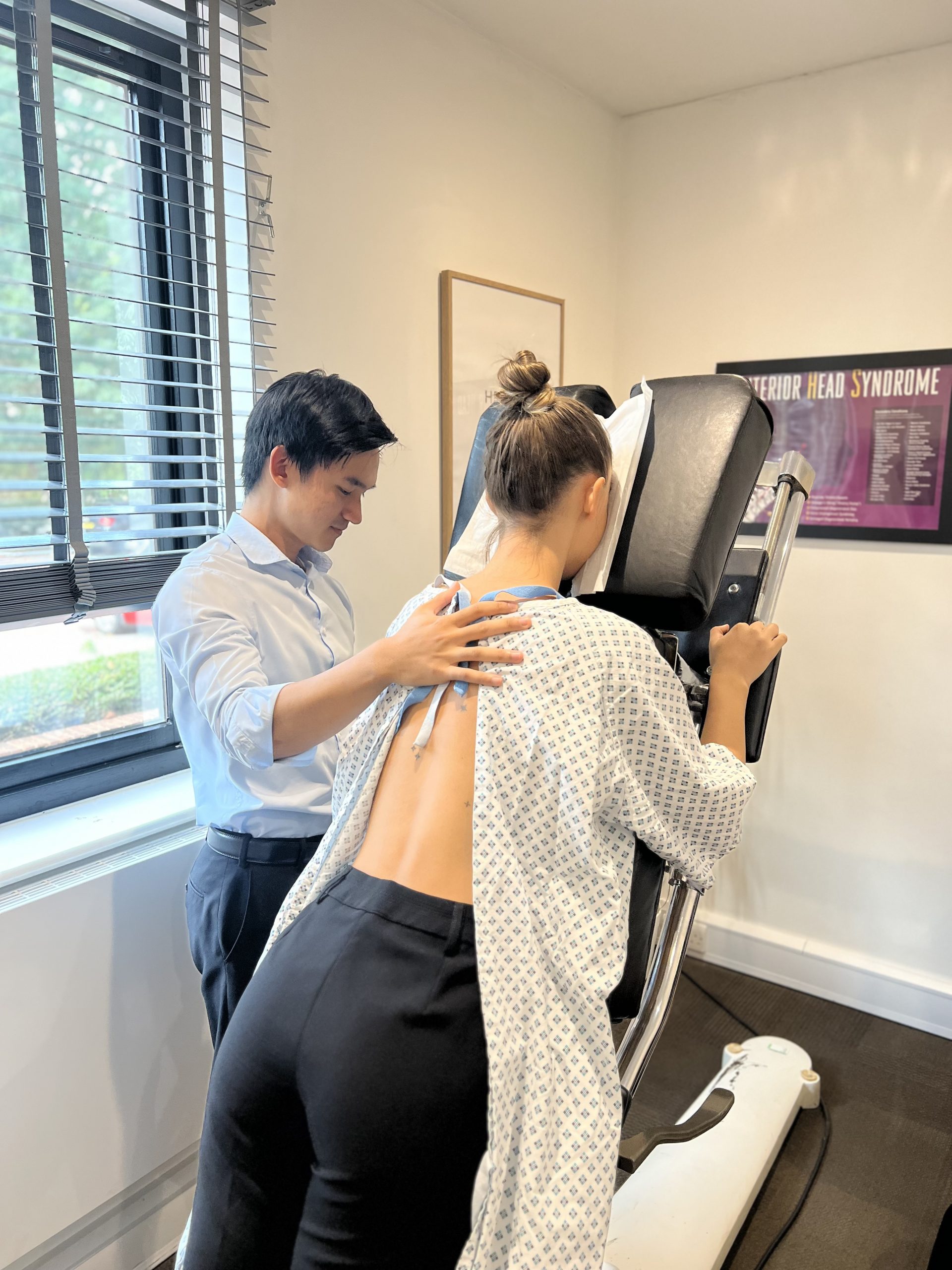
Should you worry about the sound?
Not at all. In fact, adjustments sometimes make no sound whatsoever, and that’s perfectly fine. The crack isn’t what we’re chasing. What we actually care about is removing the subluxation and restoring the normal function your body’s been asking for.
Research shows there’s no significant difference in effectiveness between an adjustment that makes a sound and one that doesn’t [Flynn et al., 2006; Moorman & Newell, 2022; Williams and Gyer, 2024]. What we’re really looking for afterward is reduced tenderness, improved range of motion, and better temperature readings. Those are the signs that things are moving in the right direction!
So next time you hear (or don’t hear) a crack on the table, just smile! Your nervous system is getting exactly what it needs.
References
- Chandran Suja, V., & Barakat, A. I. (2018). A Mathematical Model for the Sounds Produced by Knuckle Cracking. Scientific reports, 8(1), 4600. https://doi.org/10.1038/s41598-018-22664-4
- Flynn, T. W., Childs, J. D., & Fritz, J. M. (2006). The audible pop from high-velocity thrust manipulation and outcome in individuals with low back pain. Journal of manipulative and physiological therapeutics, 29(1), 40–45. https://doi.org/10.1016/j.jmpt.2005.11.005
- Haavik, H., Holt, T., & Murphy, B. (2010). Exploring the Neuromodulatory Effects of the Vertebral Subluxation and Chiropractic Care. Chiropractic Journal of Australia, 40(1), 37-44. https://chiro.org/Subluxation/FULL/Exploring_the_Neuromodulatory_Effects.pdf
- Haavik, H., Kumari, N., Holt, K., Niazi, I. K., Amjad, I., Pujari, A. N., Türker, K. S., & Murphy, B. (2021). The contemporary model of vertebral column joint dysfunction and impact of high-velocity, low-amplitude controlled vertebral thrusts on neuromuscular function. European journal of applied physiology, 121(10), 2675–2720. https://doi.org/10.1007/s00421-021-04727-z
- Kawchuk, G. N., Fryer, J., Jaremko, J. L., Zeng, H., Rowe, L., & Thompson, R. (2015). Real-time visualization of joint cavitation. PloS one, 10(4), e0119470. https://doi.org/10.1371/journal.pone.0119470
- Moorman, A. C., & Newell, D. (2022). Impact of audible pops associated with spinal manipulation on perceived pain: a systematic review. Chiropractic & manual therapies, 30(1), 42. https://doi.org/10.1186/s12998-022-00454-0
- Williams, B., & Gyer, G. (2024). Spinal Manipulation Vs Spinal Mobilization – Does the Cavitation Matter? – A Clinical Commentary. Journal of Contemporary Chiropractic, 7(1), 57-61. https://journal.parker.edu/article/94774-spinal-manipulation-vs-spinal-mobilization-does-the-cavitation-matter-a-clinical-commentary
