
Approximately 1 in 3 people are susceptible to motion sickness (1), and yet the causes are poorly understood, meaning many people just have to live with it. As a chiropractor, I see a wide range of people who suffer with similar problems. These range from mild vertigo and dizziness, to extreme car sickness. Some even experience things similar to Mal de Débarquement syndrome, where symptoms can persist for several days following travel!
Many of us have experienced some form of travel sickness at some point in our lives, but what causes it? Motion sickness isn’t just a stomach problem. It’s a data processing problem in which the brain receives several conflicting signals via the nervous system and is unable to make sense of them. The result? A ‘system error’ code of dizziness, light-headedness, nausea and vomiting.
What Goes Wrong in the Body?
Generally, the body is very clever at adapting to changes of environment and in supporting itself. In the case of balance, coordination and motion, the main systems involved are the vestibular system (inner ear) and the visual system (eyes)(2).
The vestibular system sends signals to the brain as any change is made in motion, acceleration or bodily position. Alongside this, the eyes give the brain information about your surroundings, distance and direction of movement based on what you see. If this information is ‘synced up’ and in agreement, then the brain adapts and no problems are experienced.
When these signals conflict with one another, the brain becomes confused and the all too familiar symptoms begin. This is why people often struggle with travel sickness after a long period of reading or looking down in a car. Their eyes are set on a fixed reference point, while their ears are telling the brain that they are moving.
So, How Can the Neck Be Involved?
The Science
While not guaranteed, I have seen many cases of people whose motion sickness has improved as their neck pain/problems have also resolved. The science explains why this can be the case! As we already mentioned, the eyes and the ears both detect changes in motion, but how do they send these signals to the brain? The nerves! And where do these nerves travel through in order to connect to the brain? The upper neck!
The brainstem is a small section at the base of the brain. It sits just inside the base of the skull and the very top of the upper neck. It acts as a hub where all the information collected throughout the whole body converges. Part of the many ‘data processing’ parts of the brain are located here, including the vestibular nuclei (processing balance) and the oculomotor nuclei (controlling eye movements) (3).
The Interference
The upper neck provides protection to this area and is packed full of neurological structures. The top three vertebrae in the neck (C1–C3) contain the highest concentration of proprioceptors (position sensors) in the entire body (4).
When things are working well in the neck, the body integrates and deals with this data properly. Then, the whole body can function and feel at its best. However, the neck can become stiff or injured. The resultant irritation, if significant enough to affect these nerves, can cause interference to the otherwise clear signals coming from the eyes and ears.
Suddenly the brain experiences the same ‘data processing’ error. It causes dizziness, light headedness, nausea and vomiting despite there being no problem in the eyes, ears or stomach themselves… Get the neck issue corrected, remove the source of interference, suddenly things are all clear again!
Next Steps
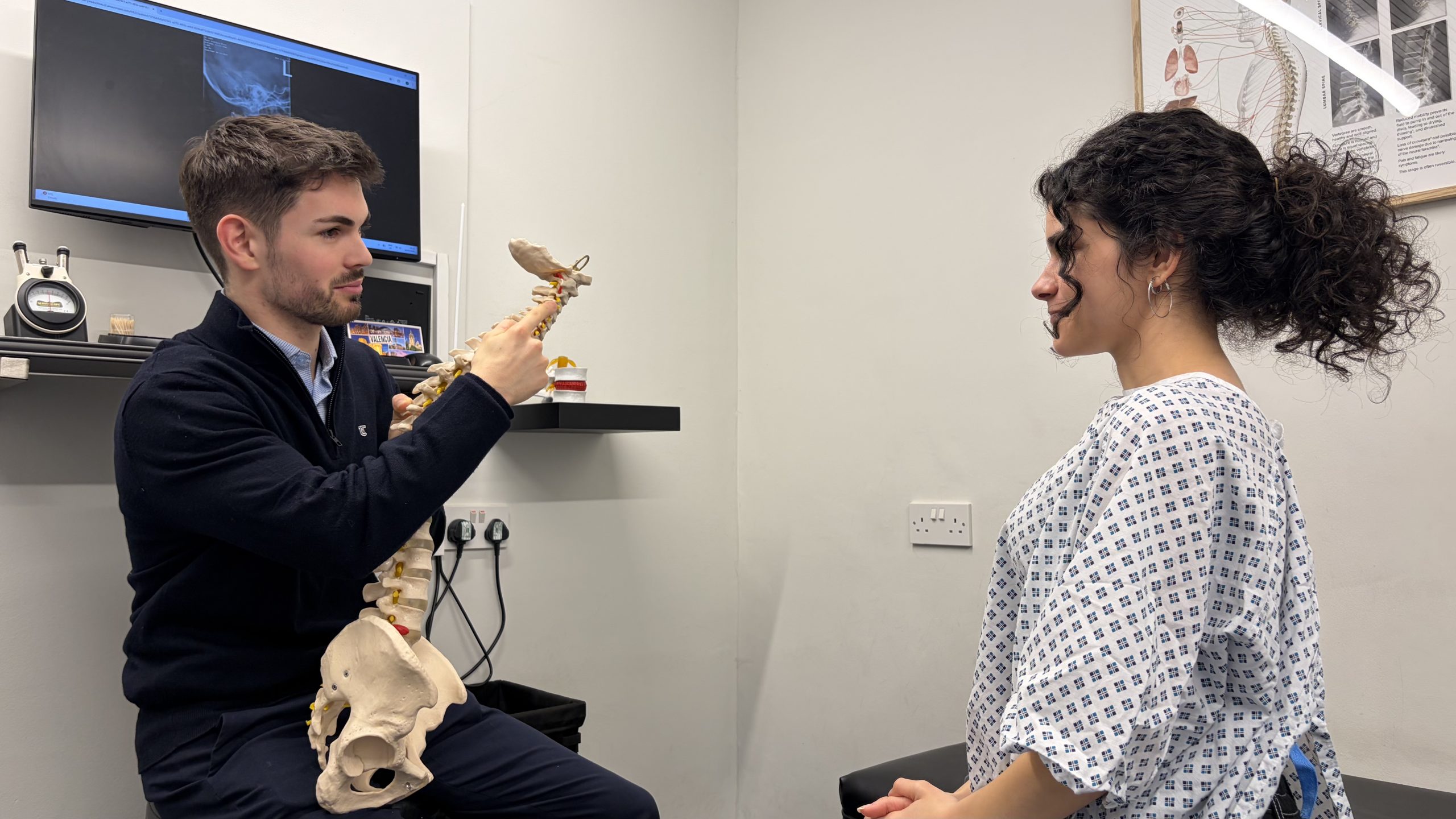
Do you struggle with travel sickness and neck issues? Have you developed travel sickness that you never used to have? It may be worth getting checked over by one of our chiropractors to see if it could be related to your neck.
References
(1) Motion sickness: MedlinePlus Genetics [Internet]. Bethesda (MD): National Library of Medicine (US); [updated 2023 Nov 2; cited 2026 Apr 17]. Available from: https://medlineplus.gov/genetics/condition/motion-sickness/
(2) The human balance system: how do we maintain our balance? [Internet]. Portland (OR): Vestibular Disorders Association; [cited 2026 Apr 17]. Available from: https://vestibular.org/article/what-is-vestibular/the-human-balance-system/the-human-balance-system-how-do-we-maintain-our-balance/
(3) Patterson AL, Sclafani JP. Motion Sickness. [Updated 2023 Jul 10]. In: StatPearls [Internet]. Treasure Island (FL): StatPearls Publishing; 2024 Jan-. Available from: https://www.ncbi.nlm.nih.gov/books/NBK544297/
(4) The body’s GPS system: the power of upper cervical spine proprioception [Internet]. New York (NY): New York Upper Cervical Chiropractic; 2021 May 24 [cited 2026 Apr 17]. Available from: https://www.newyorkucc.com/post/the-body-s-gps-system-the-power-of-upper-cervical-spine-proprioception
